Rome is a city rich in monuments and artistic heritage. Alongside its most famous tourist attractions, such as the Colosseum or the Circus Maximus, there are other lesser-known treasures waiting to be discovered, and the Tempietto di San Pietro in Montorio is one of them.
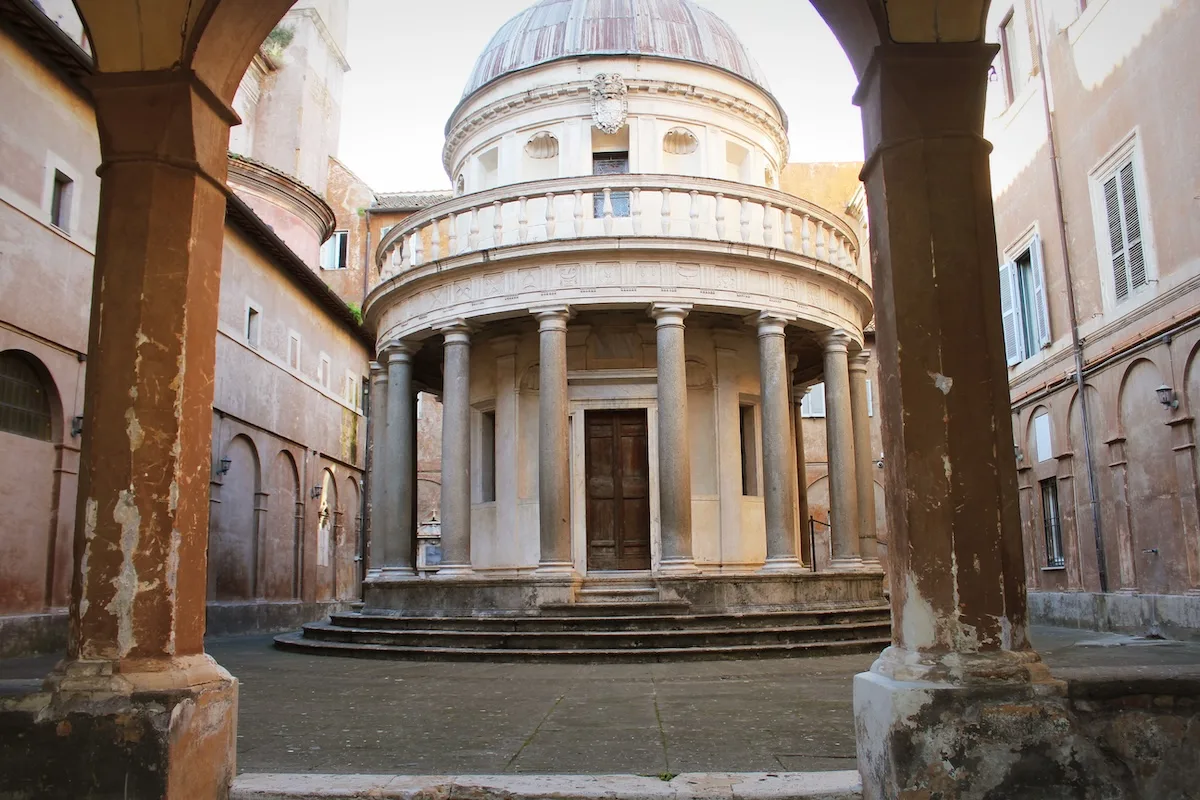
Set on the Janiculum Hill, within the complex of San Pietro in Montorio, the Tempietto del Bramante, as it is often called in honour of the architect who designed it, stands as a remarkable example of Renaissance architecture. Today, it forms part of the Royal Spanish Academy. Its history is well worth exploring.
The history of the Tempietto di San Pietro in Montorio
It was the Catholic Monarchs of Spain, Isabella I of Castile and Ferdinand II of Aragon, who commissioned the design of the Tempietto di San Pietro in Montorio from the architect Donato di Angelo di Pascuccio, better known as Bramante. Their decision stemmed from the fulfilment of a vow: the building was conceived as a monument to the martyrdom of St Peter, which, according to tradition, took place on the Janiculum Hill.
Bramante’s Tempietto stands in the first of the two cloisters belonging to the convent adjoining the church of San Pietro in Montorio. The church itself dates back to the 9th century and was rebuilt towards the end of the 15th century on what was believed to be the site of St Peter’s crucifixion.
There is no absolute certainty regarding the date of the design and construction. Some scholars believe that the project dates to 1502, while others consider 1508 a more plausible date. It was during these years, in fact, that Bramante completed some of his most significant works.
The building was immediately praised by leading architects contemporary with Bramante, including Serlio and Palladio, and went on to inspire numerous architectural projects in the years that followed.
The Tempietto del Bramante today
Bramante’s Tempietto remains almost identical to the original project—despite the fact that the initial design placed it at the centre of a circular, porticoed courtyard rather than the present square one, a feature that was never realised—with the exception of a few alterations carried out in the 17th century. On that occasion, the dome was raised slightly, the staircase leading to the crypt was reconfigured, and changes were made to the lantern.
The architect’s intention was to emphasise the idea that the site of St Peter’s crucifixion marked the symbolic centre of Rome, and indeed of the world. In Bramante’s vision, that spot was to become the pivotal point from which papal authority would radiate.
What to see besides the Tempietto del Bramante
The complex of San Pietro in Montorio also houses the Royal Academy of Spain, located within its second cloister. The Academy preserves a remarkable artistic heritage, with works collected since its foundation in 1873. Among the highlights of its Collection of Plaster Casts is the “Zeus of Otricoli from the Vatican”, a reproduction of the head unearthed during excavations in Otricoli between 1776 and 1784.
One of the most significant sections of the Academy’s art collection is the Portrait Gallery, which honours all the artists who have been part of the institution over the decades. The library, meanwhile, holds an extensive range of volumes dedicated to the history of Spanish art and architecture. Its holdings include around 12,000 monographs and 150 specialist periodicals, all available for consultation.
The interior of the church also preserves masterpieces by artists from the 16th and 17th centuries. The first chapel on the right contains Sebastiano del Piombo’s Flagellation and Transfiguration.
The next chapel features a series of frescoes attributed to artists such as Pomarancio, Baldassarre Peruzzi and members of Pinturicchio’s school. The Chapel of the Monte is adorned with frescoes by Giorgio Vasari.
The high altar is the work of Giulio Mazzoni, and beneath it lie the funerary monuments of Cardinal Del Monte and Roberto Nobili, both attributed to Bartolomeo Ammannati. Of particular note is the second chapel on the left, the Raimondi Chapel, which was designed by Bernini.
How you can visit
The complex is open to visitors from Tuesday to Sunday. Opening hours run from 10:00 to 18:00, with last entry at 17:30.
The Royal Academy of Spain is located at Via Garibaldi 33.
Article translated by Agnese Giardini
 Subscribe to our newsletter
 to keep up to date with our latest news
Subscribe with your email address to receive the latest news, updates and practical tips from the real estate world directly in your inbox
