Just a few steps from the lagoon, the Doge’s Palace still tells the story of Venice at the height of its authority and symbolism. Overlooking St Mark’s Square, it served for centuries as the heart of political power in the Serenissima.
Today, it is one of the city’s most visited landmarks, not only for its Gothic architecture or the richness of the artworks it contains, but because walking through its halls means tracing the history of one of the most influential powers in the Mediterranean.
The history of the Doge’s Palace in Venice
The origins of the Doge’s Palace date back to the ninth century, when the first fortified residence was built to house the doge and safeguard the city. After the devastating fire of 976, and again following another blaze in 1106, the complex was gradually reconstructed and enlarged. It was during the fourteenth century, under the dogeship of Bartolomeo Gradenigo, that the palace acquired its present Gothic appearance, characterised by elegant loggias, rich marble decoration and a refined balance between political authority and architectural grace.
Over the centuries that followed, the palace underwent numerous expansions and alterations, as each doge sought to leave a visible sign of his power and prestige. With the fall of the Venetian Republic in 1797 and the arrival of Napoleon, the palace lost its political function and was later used as an administrative centre during Austrian rule. Only in the nineteenth century did a systematic programme of restoration and musealisation begin, eventually leading to its opening to the public in the form we recognise today.
How the Doge’s Palace in Venice is structured
The Doge’s Palace is organised around a central courtyard, dominated by the impressive Scala dei Giganti, where the doge’s coronation ceremony once took place. The external façades, overlooking the lagoon and St Mark’s Square, are notable for the elegance of their ogival arches and the delicate appearance of the pink and white marble cladding.
Inside, the building is arranged into a series of rooms, each with a distinct purpose:
- The institutional halls, including the Great Council Hall and the College Hall, which were used for assemblies and governing councils of the Republic;
- The Doge’s Apartments, the private living quarters of the doge, richly decorated with stucco work, frescoes and period furnishings;
- The prisons and secret passages, reached by crossing the famous Bridge of Sighs, which linked the palace to the prison buildings;
- The armouries, housing collections of ancient weapons, armour and defensive equipment belonging to the Serenissima.
The entire museum itinerary is designed to guide visitors from the splendour of power to the severity of justice, and into the everyday life of the doge and other officials.
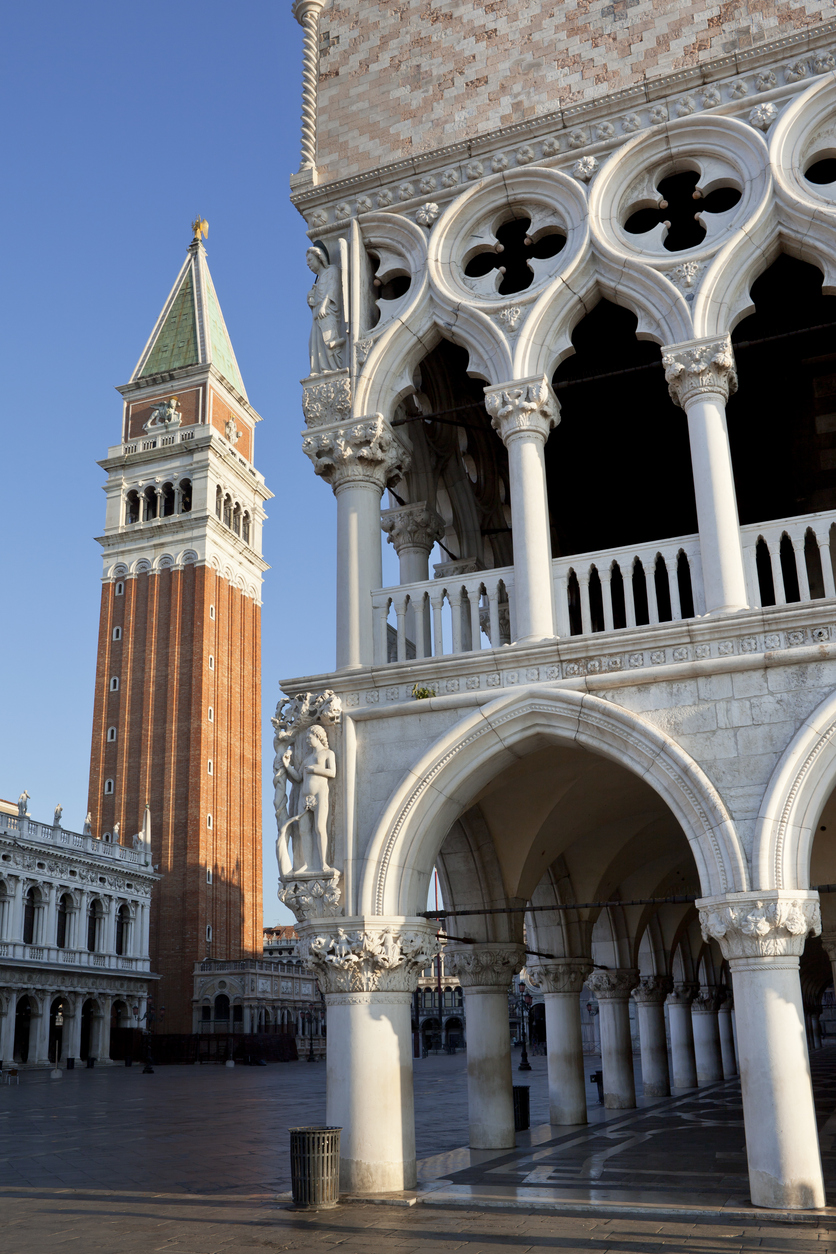 Doge’s Palace and Campanile di San Marco
What are the most important works in the Ducal Palace
In addition to its architectural value, the Doge’s Palace is a veritable picture gallery. Inside, you can admire masterpieces by some of the most important Venetian artists of the Renaissance and Baroque periods.
“Paradise” by Jacopo Tintoretto, in the Hall of the Great Council, is one of the largest canvases in the world. It was painted with hundreds of angelic figures representing eternal bliss and heavenly harmony, a symbol of the Republic’s glorious destiny. Tintoretto also painted works in the Hall of the Scrutiny.
Veronese, in the Sala del Collegio, left some of his finest compositions, including “The Apotheosis of Venice”, a visual allegory of Venetian power and grandeur. Alongside these are works by Titian, Palma the Younger and other key painters of the Venetian school.
Decorated wooden ceilings and Renaissance-style gilding also make the palace a precious setting throughout.
Some interesting facts about the Ducal Palace
One of the most famous stories associated with the Doge’s Palace involves Giacomo Casanova, who in 1756 famously escaped from the palace prisons known as “I Piombi”. These cells were named after the lead sheets that lined the roof. His daring escape played a key role in shaping the legend of the notorious Venetian libertine.
Another intriguing detail can be found in the capitals of the columns in the palace arcade. Each one is carved with different symbols and scenes, ranging from biblical and mythological imagery to allegorical representations. Together, they reflect the founding values of the Republic, including justice, strength, prudence and harmony.
Finally, the Bridge of Sighs, built in 1602 from white Istrian stone, owes its evocative name to legend. It is said that condemned prisoners would sigh as they crossed the bridge, catching a final glimpse of the sky and the lagoon before being led to their cells.
How to get to the Ducal Palace
The Doge’s Palace is located in the very heart of Venice, in St Mark’s Square, and is easy to reach from anywhere in the city.
If you arrive in Venice by train, you can take vaporetto line 1 or 2 from either Piazzale Roma or Santa Lucia railway station and get off at the San Zaccaria stop. From there, it is just a short walk to the palace.
If you are arriving by air, you can take a direct connection on the Alilaguna blue line, a speedboat service linking Marco Polo Airport with Venice’s historic centre.
What are the visiting hours of the Doge’s Palace in Venice?
The Doge’s Palace in Venice is open every day, although opening hours vary according to the season. From 1 April to 31 October, during the spring and summer period, the palace is open from 9.00 am to 7.00 pm. From November to March, it closes earlier at 6.00 pm. In both periods, the last admission is one hour before closing.
During the summer season, from May to September, extended evening opening is offered on Fridays and Saturdays, when the palace remains open until 11.00 pm.
The entrance ticket also includes access to several other museums overlooking St Mark’s Square, including the Correr Museum, the National Archaeological Museum and the Monumental Rooms of the Biblioteca Marciana. Reduced tickets are available for students, visitors aged over 65, young people and residents of the City of Venice. Admission is free in certain cases, such as for children under five, people with disabilities and visitors covered by specific cultural agreements.
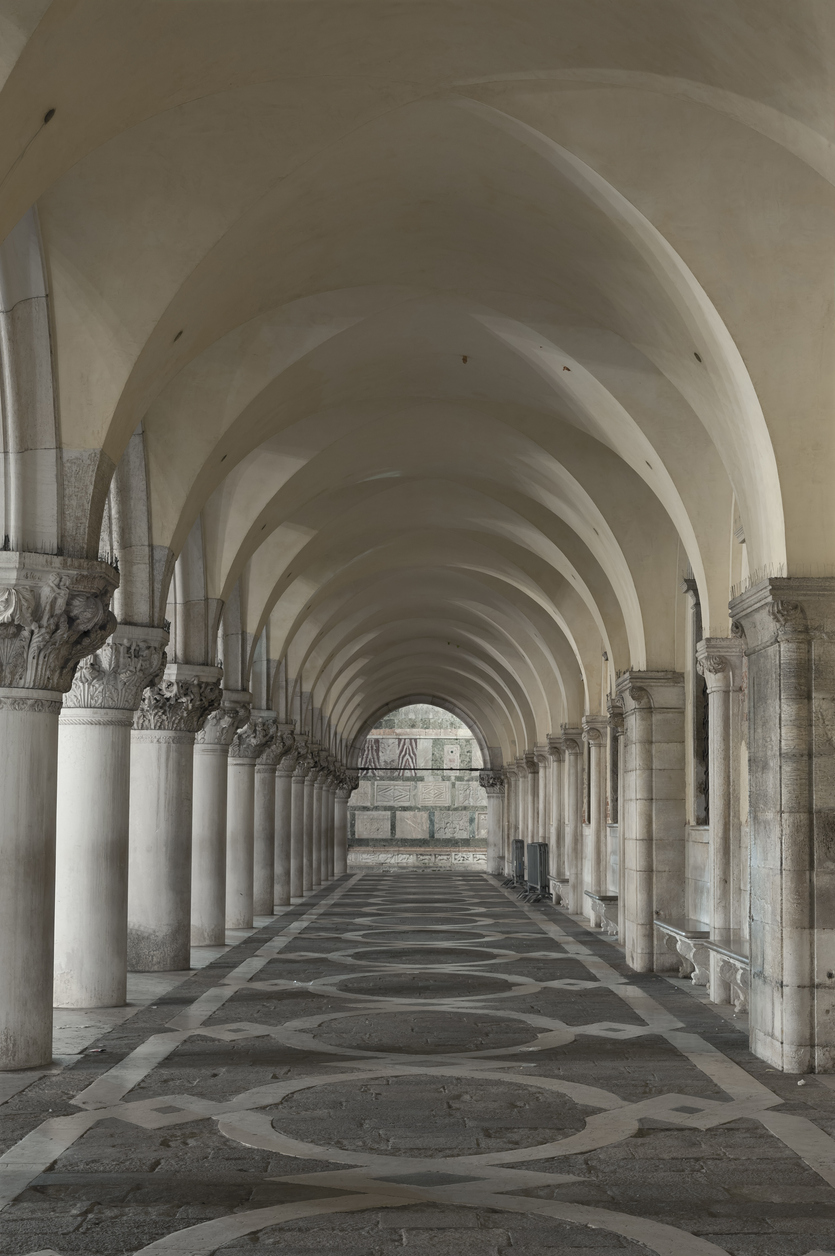 Arcades of the arcades of the Ducal Palace
How best to prepare for your visit
To make the most of your visit to the Ducal Palace, we recommend the following:
- Book your tickets online in advance to avoid queues, especially during the high season.
- Allow at least two hours for your visit, or longer if you would like to explore the prisons, museums and temporary exhibitions at a relaxed pace.
- Wear comfortable shoes, as the route is long and involves a fair amount of walking.
- Consider joining a guided tour, which may include access to areas usually closed to the public, such as secret cells or the archives.
For an even more atmospheric experience, evening or themed tours are available by reservation, including options such as “The Secrets of the Doge” and “Venice and Justice”.nd Justice.”
*Article translated by Agnese Giardini.
 Subscribe to our newsletter
 to keep up to date with our latest news
Subscribe with your email address to receive the latest news, updates and practical tips from the real estate world directly in your inbox
