When talking about Verona, two iconic landmarks immediately come to mind: the Arena di Verona, the fourth largest Roman amphitheater in Italy, and “Romeo and Juliet”, the famous tragedy by William Shakespeare, inspired by “Historia Novellamente Ritrovata di Due Nobili Amanti” by Luigi da Porto.
Located in Piazza Bra, the Arena di Verona is an unmissable attraction in Verona and a must-see for visitors to the city. Throughout the year, this extraordinary Roman amphitheater hosts numerous cultural events and concerts, most notably the world-famous Arena Opera Festival, held annually since 1936.
Let’s explore where the Arena is located, its ancient history, and how to visit the Arena di Verona.
Where the Arena di Verona Is Located and How to Get There
The Arena di Verona stands in the heart of Verona’s historic center, in Piazza Bra, the largest and most representative square in the city. It rises along the Liston, the elegant pedestrian promenade lined with historic buildings and charming cafés, just a short walk from Via Mazzini, Verona’s main shopping street leading to Piazza delle Erbe. Nearby, visitors will also find Palazzo Barbieri, home to the City Hall, and the Bra Gardens.
Thanks to its central location, the Arena is easy to reach:
- about 1.5 kilometers from Verona Porta Nuova railway station, a pleasant 15–20 minute walk;
- around 10 minutes by city bus, with several lines stopping directly in Piazza Bra;
- by car, using paid parking areas near the historic center, keeping in mind that the area can be particularly busy during events and performances.
The History of the Arena di Verona
There is no absolute consensus on the exact construction date of the Arena di Verona. However, the most widely accepted theory places its construction in the 1st century AD, likely during the Augustan age or under the Julio-Claudian dynasty.
Originally built outside the city walls, its location served practical and organizational purposes: allowing large crowds to attend public spectacles. The Arena hosted gladiator fights and venationes (wild animal hunts), events that attracted spectators from across the surrounding territories.
After the fall of the Roman Empire, the amphitheater experienced periods of decline and suffered significant damage, particularly due to powerful earthquakes that partially destroyed its outer ring. During the Middle Ages, the structure was repurposed for markets and public gatherings, becoming an integral part of Verona’s civic life.
The true rebirth of the Arena came in the modern era through major restoration efforts. A decisive moment occurred in 1913, when “Aida” by Giuseppe Verdi was staged inside the amphitheater to celebrate the centenary of the composer’s birth. Since then, the Arena di Verona has become an international landmark for opera and live music, hosting the prestigious Arena Opera Festival every year along with concerts by world-renowned artists.
Legends About the Arena di Verona
Several fascinating legends about the Arena di Verona have circulated over the centuries.
During the Middle Ages, it was said that a noble Veronese man was accused of a terrible crime and sentenced to death. To save his life, he promised to build a gigantic structure capable of hosting all the citizens of Verona and staging public performances.
In order to complete the amphitheater in time, he allegedly sold his soul to the devil, who agreed to build the structure between the evening and morning Ave Maria. Throughout the night, demons gathered to construct the Arena.
However, the condemned man repented and prayed to the Virgin Mary all night. She granted him mercy: the sun rose two hours early, and at the morning Ave Maria, the devils disappeared underground. The construction remained unfinished, which—according to legend—explains the incomplete outer section known as the Ala.
Architecture of the Arena di Verona
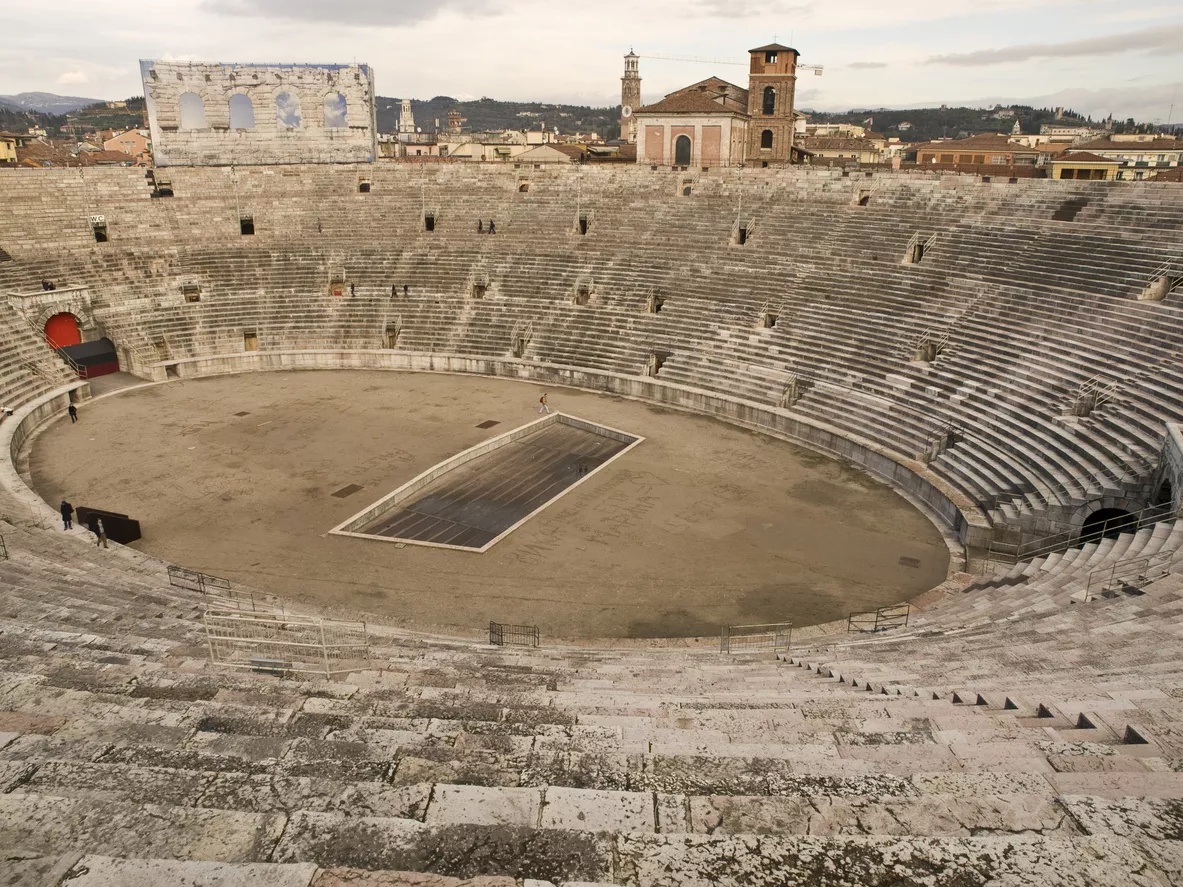
The Arena di Verona features an elliptical layout, typical of Roman amphitheaters, designed to ensure excellent visibility from every seat and facilitate the flow of spectators.
Originally, it could accommodate up to 30,000 spectators, seated along the stone tiers surrounding the central arena where performances took place.
Today, only a portion of the original outer ring remains visible: the Ala, composed of four arches. The rest collapsed following the devastating earthquake of 1117, one of the most powerful seismic events to strike Verona during the Middle Ages.
The original façade consisted of three superimposed orders of arches, built with white and pink limestone from the Valpolicella area, giving the monument its distinctive and monumental appearance.
Inside, the amphitheater is divided into two main sections:
- The arena, the central elliptical performance space;
- The cavea, the seating area for spectators.
Access routes were carefully designed with corridors and stairways to allow rapid entry and exit. The western sector was likely the most prestigious, accessed through the grandest entrance, featuring a central vault almost twice as high as the others—suggesting it was reserved for authorities or distinguished guests.
How to Visit the Arena di Verona
Tickets
Visitors can purchase Arena di Verona tickets either online or directly at the ticket office.
- Full ticket: €12.00
- Reduced ticket: €9.00 (for visitors over 60, groups, and students with valid ID)
- Young adults (18–25 years): €3.00
- Free entry: minors, people with disabilities, and VeronaCard holders
On the first Sunday of every month, admission costs only €1.00.
Opening Hours of the Arena di Verona
The Arena di Verona opening hours generally run from Tuesday to Sunday, 9:00 AM to 7:00 PM, closed on Mondays. However, schedules may vary due to performances, concerts, or restoration work.
October to May:
- Tuesday to Sunday: 9:00 AM – 7:00 PM (last entry at 6:30 PM)
- Closed on Monday
June to September:
- Monday: 9:00 AM – 7:00 PM (last entry at 6:30 PM)
- Tuesday to Sunday: 9:00 AM – 5:00 PM (last entry at 4:00 PM)
The monument is closed on December 25 and January 1.
 Subscribe to our newsletter
 to keep up to date with our latest news
Subscribe with your email address to receive the latest news, updates and practical tips from the real estate world directly in your inbox
